Technology Trends, Selection Guide, and Application Practices
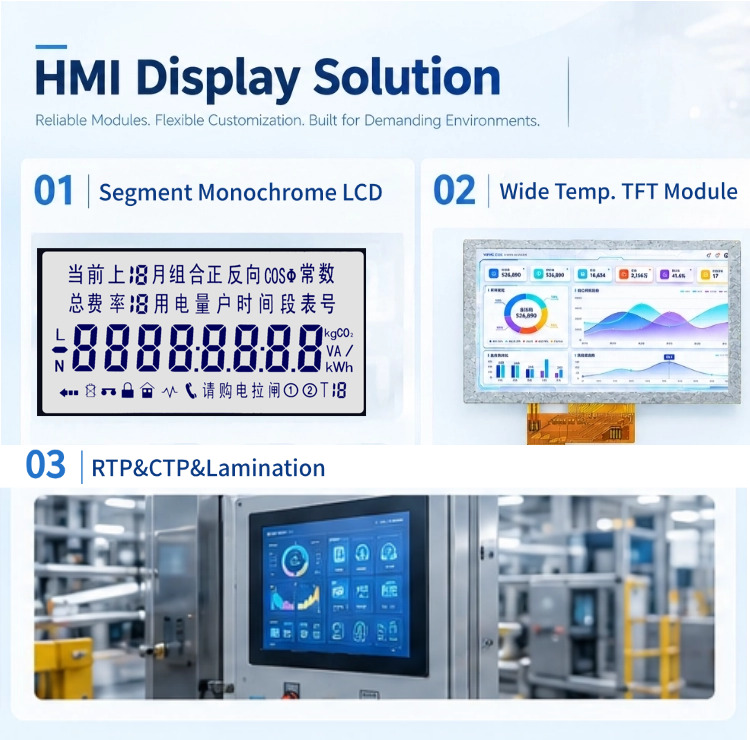
As home appliances continue to evolve toward intelligent and connected systems, user expectations for intuitive interaction and operational efficiency are steadily increasing. Graphical User Interfaces (GUI) are rapidly replacing traditional button-based designs, making display modules a critical component in defining both user experience and industrial design capabilities.
Against this backdrop, the performance and selection of smart home appliance display modules play a key role in product differentiation and functionality realization.
1.Industry Trends in Home Appliance Display Technologies
1.1 Coexistence of Multiple Display Technologies
As application scenarios continue to expand, product development must still balance performance and cost. As a result, the home appliance display market is characterized by the coexistence of multiple technology routes:
- TFT-LCD display modules: Widely adopted due to maturity, cost efficiency, and reliability
- IPS technology: Enhances viewing angles and display consistency
- OLED/AMOLED displays: Preferred in high-end appliances for superior contrast and visual performance
These technologies are not mutually exclusive but are selected based on product positioning and application requirements.
1.2 Structural Differentiation in Size and Functionality
Display module size selection is closely related to product positioning, usage frequency, and interaction complexity. Instead of a simple trend toward larger screens, the market shows clear segmentation:
- Small-size modules: Focus on basic control and status display
- Mid-size modules: Balance interaction and functional display
- Large-size modules: Support advanced UI and multi-functional integration
1.3 Higher Requirements for Environmental Adaptability
Compared with consumer electronics, home appliances operate in more demanding environments, such as high temperature, humidity, and fluctuating conditions.
Therefore, display modules must meet higher standards, including:wide operating temperature range,long-term operational stability,resistance to moisture and electromagnetic interference.
1.4 Increased Integration with Industrial Design
With the advancement of industrial design, display modules are evolving from standard components to customized integrated solutions. This includes:display and front panel integration,touch and display module integration,alignment between UI design and hardware capabilities
This trend places higher demands on suppliers’ system integration capabilities.
2.How to Choose a Smart Home Appliance Display Module
When selecting a display module for home appliances, manufacturers should evaluate the following key factors.
2.1 Display Performance and Readability
A high-quality display module should ensure:
- Adequate brightness and contrast
- Accurate color reproduction
- Wide viewing angles (IPS preferred)
2.2 System Compatibility and Development Efficiency
Display modules should support efficient integration through:
- Standard interfaces (e.g., SPI, MIPI)
- Driver and software support
- Ease of debugging and system integration
2.3 Size Selection Based on Application
Different display sizes are typically matched with specific appliance types:
- 2″–2.8″ small displays: Used in microwaves and ovens for basic control
- 6″–7″ mid-size displays: Common in washing machines for program selection
- ~9″ displays: Increasingly used in refrigerators for enhanced interaction
- 10″+ large displays: Applied in high-end appliances for advanced UI and multi-interface control
This layered application structure reflects the growing demand for differentiated user experiences.
3.Application Scenarios of Display Modules in Home Appliances
Display modules are widely used across various smart appliance categories:
- Kitchen appliances (microwaves, ovens)
- Laundry appliances (washing machines)
- Refrigeration appliances (smart refrigerators)
Different application scenarios require tailored display performance, structure, and interface solutions.
4.TOPTE Display Module Solutions for Smart Home Appliances
As a professional display module supplier, TOPTE has developed comprehensive solutions for smart home appliance applications, covering a wide range of sizes and use cases.Key capabilities include:
- Full product range from 2-inch to over 10-inch TFT-LCD display modules
- Support for multiple display technologies including TFT-LCD
- Integrated display and touch solutions
- Extensive application experience in refrigerators, washing machines, and kitchen appliances
- High-level customization capabilities
In practical projects, TOPTE works closely with customers to optimize display performance, structural design, and interface solutions based on specific product requirements and operating environments, thereby improving overall development efficiency.
FAQ (Frequently Asked Questions)
Q1:What is a smart home appliance display module?
A display module used in appliances such as washing machines, refrigerators, and ovens to enable user interaction and system control.
Q2:How to choose a TFT LCD display module for home appliances?
Key factors include brightness, reliability, temperature range, interface compatibility, and customization capability.
Q3:What type of display is commonly used in washing machines?
TFT-LCD or IPS display modules with touch functionality are commonly used.
Q4:What size display is used in smart refrigerators?
Typically between 7-inch and 10-inch or larger, depending on functionality and UI complexity.