Electronic counters are widely used in inventory management, production tracking, attendance recording, and various handheld counting applications. While product designs differ, their display requirements are generally similar: clear numeric visibility, low power consumption, and reliable operation under different lighting conditions.
Common display solutions for electronic counters include segment LCDs, OLED displays, and small-size TFT LCD modules. Each technology offers different advantages depending on the application.
Common Display Technologies
1.Segment LCD
Segment LCDs remain the most cost-effective option for basic counting devices.
Advantages:
- Extremely low power consumption
- Long service life
- Low manufacturing cost
Limitations:
- Limited to fixed numbers and icons
- No graphical display capability
- Additional backlighting may be required in low-light environments
2.OLED Displays
Small OLED displays provide high contrast and excellent visibility in dark environments.
Advantages:
- Self-emissive display technology
- High contrast ratio
- Wide viewing angles
Limitations:
- Potential burn-in when displaying static content for long periods
- Outdoor visibility may be affected under strong sunlight
3.TFT LCD Displays
TFT LCD modules offer greater flexibility for products that require more than simple numeric display.
They support graphical interfaces, status indicators, logos, and multilingual information while maintaining good visibility in both indoor and outdoor environments.
1.3-Inch WQVGA TFT LCD Module
For applications requiring a compact and flexible display solution, TOPTE has developed a 1.3-inch WQVGA TFT LCD module supplied in a single-LCM structure.
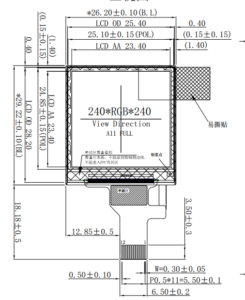
Specifications
| Parameter | Specification |
| Display Size | 1.3 Inch |
| Resolution | 240 × 240 |
| Thickness | 1.43 mm |
| Brightness | 650 cd/m² (Min.) |
| Operating Temperature | -20°C to 70°C |
| Storage Temperature | -10°C to 60°C |
Compared with many conventional TFT modules that are typically around 2 mm thick, this design reduces the overall module thickness to 1.43 mm, providing greater flexibility for compact product designs.
What Makes This Design Different?
The main distinction is its single-LCM structure.
Rather than supplying a fully assembled display module, manufacturers can choose their own integration approach, including:
- Backlight configuration
- Cover lens materials
- Surface treatments
- FPC routing and connector design
This flexibility can be valuable for products with unique mechanical requirements or customized industrial designs.
Recommended Applications
This module may be a suitable option for products that require:
- Compact internal structures
- Customized cover glass solutions
- Color graphics or status indicators
- Better visual presentation than segment LCDs
Typical examples include handheld counters, portable instruments, and compact control devices.
Conclusion
Selecting a display for an electronic counter involves balancing cost, power consumption, visibility, and product design requirements.
For applications that require graphical display capability and a thinner mechanical structure, the 1.3-inch WQVGA TFT LCD module offers a practical alternative to traditional display solutions. Its compact profile and flexible integration options make it particularly suitable for manufacturers looking to optimize both appearance and functionality.