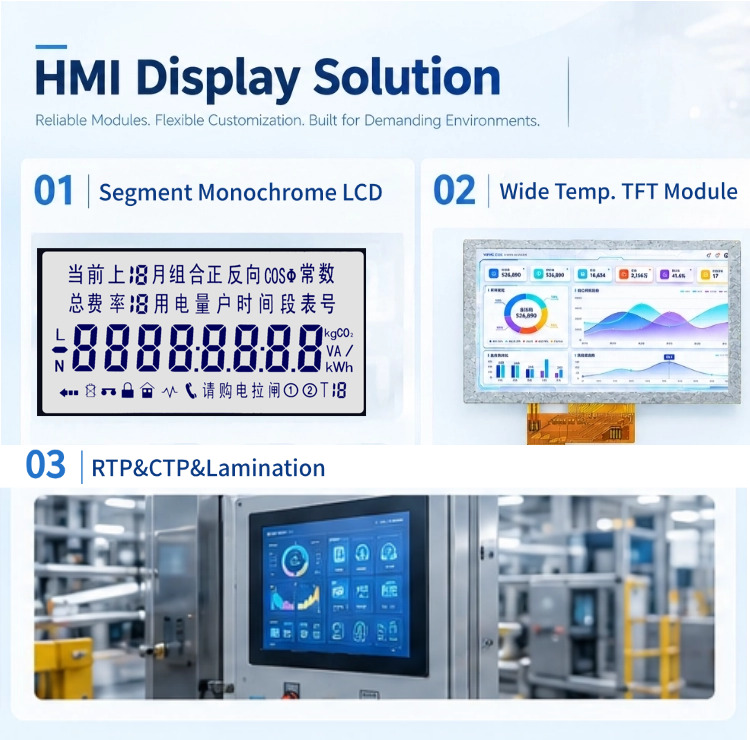
While OLED is widely used in consumer electronics, LCD display modules remain the preferred choice for industrial, retail, and automotive applications.
This guide provides a real-world comparison of LCD vs OLED across key industries, helping you choose the right solution based on performance, cost, and reliability.
Why Application Matters More Than Technology
Many buyers focus on LCD vs OLED as a technology comparison, but in practice:The best display depends on the application scenario, not just specs.
For example:
- A sunlight readable LCD display is essential in automotive
- A low power LCD module is critical for ESL systems
- A long lifespan display is required in industrial equipment
Smart Retail Displays — Why LCD Dominates
Typical Use Cases
• Electronic Shelf Labels (ESL)
• Digital signage LCD screens
• Smart pricing displays
Why LCD Is Preferred
1. Low Power Consumption
Retail systems require thousands of displays.
Low power LCD displays significantly reduce operational costs.
2. Cost Efficiency
LCD is more suitable for large-scale deployment compared to OLED.
3. Stability for Long-Term Use
Retail displays often run 24/7, where LCD performs more reliably.
Industrial LCD Displays — Reliability Comes First
Typical Use Cases
- Industrial control panels
- Automation systems
- HMI (Human Machine Interface)
Key Requirements
- Long lifespan (5–10 years)
- High reliability
- Resistance to temperature and vibration
Why LCD Wins
- Proven stability
- No burn-in issues
- Wide availability of TFT LCD modules
Automotive Displays — High Brightness Is Critical
Typical Applications
- Instrument clusters
- Infotainment systems
- Rear-seat displays
Why LCD Is Widely Used
✔ High Brightness (Sunlight Readable)
LCD can reach higher brightness levels, making it ideal for outdoor visibility.
✔ Temperature Stability
Automotive environments require displays that can operate from -30°C to 85°C.
✔ Cost Control
Mass production favors LCD display modules.
When OLED Is the Better Choice
OLED is suitable for:
- High-end consumer electronics
- Ultra-thin or flexible designs
- High contrast visual applications
However, limitations include:
- Higher cost
- Potential burn-in
- Shorter lifespan in static display scenarios
LCD vs OLED: Quick Application Decision Guide
| Application | Recommended Technology |
|---|---|
| Smart retail display | LCD |
| Industrial display | LCD |
| Automotive display | LCD |
| Consumer electronics | OLED |
FAQ
1.Is LCD better than OLED for industrial use?
Yes. LCD offers better durability, longer lifespan, and higher reliability.
2.Why is LCD still used in automotive displays?
Because of its high brightness, temperature stability, and cost efficiency.
3.Is OLED replacing LCD?
No. OLED is growing in consumer electronics, but LCD still dominates commercial and industrial applications.
TOPTE offers:
- Custom LCD display modules
- 0.9”–15.6” sizes tft display
- Solutions for smart retail, industrial, and automotive applications